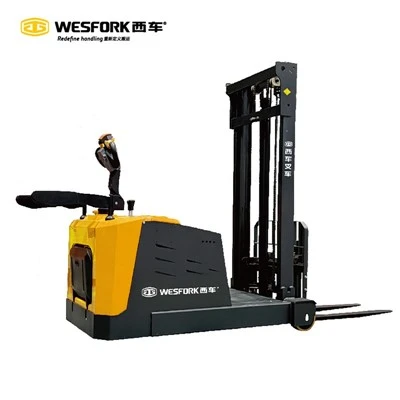
Alright, let’s cut to the chase—if you’re in the warehouse, manufacturing, or distribution game, you’ve probably seen a counterbalance stacker doing its thing. It’s that workhorse that lifts pallets, shoves them into racking, and shuffles heavy loads around tight corners like it’s nothing. But here’s the question I get all the time from shop managers and forklift operators: “What’s the gradeability of a counterbalance stacker, and why does it even matter?” Counterbalance Stacker

As a counterbalance stacker supplier, I’ve spent years answering this exact question, usually over a coffee while we look at a broken pallet or a misjudged incline that caused a tiny (super avoidable) fender bender. Let’s break this down without the stuffy engineering jargon—no “coefficient of traction” thrown around unless I explain it like we’re chatting by the loading dock.
First, let’s define gradeability in plain terms, not some textbook blurb. Gradeability is how steep a slope a piece of equipment can climb (or descend) while carrying its rated load without sliding, stalling, or tipping. For a counterbalance stacker specifically, this is non-negotiable because most warehouses aren’t perfectly flat—there are loading dock ramps, sloped driveways to the yard, maybe even a wonky section in the concrete that’s a tiny incline no one bothered to fix.
Now, here’s the part that surprises a lot of people: counterbalance stackers don’t all have the same gradeability. If you’ve used a cheap, no-name stacker from a discount seller, you’ve probably noticed it can barely make it over a 3-degree slope with a half-full pallet. But our stackers (the good ones, the ones that actually last) are built with gradeability that’s tailored to what you actually need. Let’s get into the numbers, but keep them real—no “15% gradeability” without context.
Most standard electric counterbalance stackers (the ones most warehouses use) have a gradeability range of roughly 8% to 12% when loaded. Wait, 8% to 12%—what does that look like? A 10% grade is about a 5.7-degree slope. If you’ve ever walked up a ramp that looks like a slight hill you don’t break a sweat on, that’s roughly 10%. A 12% grade is steeper—think the ramp to a big rig trailer when it’s at its highest setting, that’s around 12%. Our heavy-duty models? We’ve got some that hit 15% gradeability for when you’re dealing with outdoor yards that have a bit of a slope, or loading docks that need a steeper ramp for quick turnarounds.
But here’s the big caveat: gradeability isn’t one-size-fits-all. It changes based on three things that matter way more than the spec sheet number. First, the load weight. If you’re running a stacker with a 2,000-lb capacity, that’s a lot different than a 5,000-lb capacity. The heavier the load, the more traction you need, so gradeability drops a little when you’re maxing out the load vs. running empty. Second, the surface. Concrete that’s smooth and clean has different traction than dirty, oily, or gravelly ground. If you’re using your stacker outdoors on a gravel lot, that 10% grade? It’s going to feel like a 14% grade because the tires slip a little. Third, speed. Trying to climb a slope at full speed is way harder than creeping up it slow and steady—most stacker specs use a “creep speed” when measuring gradeability, so don’t think you can gun it up a hill and hit the same number.
Now, why does this matter to you, the person actually using the stacker, not just some engineer in an office? I’ll give you a real story from a customer last year. They had a loading dock ramp that was listed as 8% grade, and they were using a cheap old stacker from a company that wouldn’t name (let’s just say it rhymes with “Budget Lift”). They kept having issues where the stacker would stall halfway up, or slide back a little, scuffing the dock and almost dropping the pallet. They came to us, and we looked at their setup—their load was 1,800 lbs, the ramp was slightly oily, and they were trying to climb it at full speed. We swapped them to a medium-duty stacker with 10% gradeability, adjusted their speed, and added slightly treaded tires for better traction on smooth concrete. No more stalls, no more scuffs, and they got their loading time down by 10 minutes a day. That’s the kind of real-world difference gradeability makes.
Another thing people don’t talk about: counterbalance stackers are different from forklifts when it comes to gradeability. Wait, why? Because forklifts are bigger, have more powerful engines, and often have pneumatic tires for outdoor use. Most counterbalance stackers are electric, use solid rubber tires, and are built for indoor use mostly. So their gradeability is lower than a forklift, but that’s okay—because 90% of the time, you’re moving them inside, not hauling them up a mountain. But if you are moving them outdoors, you need to adjust your expectations. I always tell customers: if you’re crossing between a warehouse and a yard, go for a model at the higher end of the gradeability range, like 12% or 15%, and make sure you’re using it on clean, firm surfaces.
Let’s also bust a myth: more gradeability isn’t always better. If you have a perfectly flat warehouse, paying extra for a stacker with 15% gradeability is just throwing money away. You’re paying for features you’ll never use, which drives up your upfront cost and maybe even your maintenance. We always work with customers to figure out their exact needs—do you have a loading dock ramp? Do you use it outdoors? How often? That way, you’re not overspending or ending up with a stacker that can’t handle the slopes you do have.
Now, the technical stuff, simplified (I promise). The gradeability of a counterbalance stacker depends on two main systems: the motor and the traction control. A stronger electric motor can push the stacker up steeper slopes, but you don’t want a motor that’s too big because it’s less efficient and uses more battery. Traction control is key too—our stackers have built-in systems that prevent the wheels from slipping when you’re on a slope, so you don’t lose power mid-climb. Solid rubber tires are standard, but we offer a rugged tread option for outdoor use that boosts traction by 20% on rough surfaces, which translates to better gradeability.
Battery life ties into this too, by the way. If you’re climbing a slope while also lifting a load, that uses more battery power. A stacker with good gradeability should still maintain its lift capacity when on a slope—some cheaper models will cut the lift power when they’re on an incline, which is a total headache because you’re trying to put a pallet in a high rack and your lift just dies halfway up. Our stackers don’t do that, because we designed the motor and lift system to work together even on sloped terrain.
Let’s get back to that customer story, because it’s relatable. They were using a stacker that had a spec of 8% gradeability, but when we tested their ramp, they needed at least 9% to 10% to get up without issues. The cheap model they had just couldn’t deliver when the load was at 1,800 lbs and the surface was slightly oily. We also trained their operators to take slopes slow, which helped a lot—many operators want to rush, but slow and steady on a slope is way safer and more effective.
Here’s the thing I want you to take away: gradeability isn’t just a number on a spec sheet. It’s a feature that directly impacts how safe, efficient, and productive your warehouse is. If you’re constantly dealing with ramps, uneven floors, or outdoor movement, you need to pay close attention to this. If you’re in a totally flat facility, you can focus on other features like lift height and maneuverability.
Now, I know you’re probably thinking, “Okay, so how do I figure out what gradeability I need for my operation?” That’s where we come in. As a counterbalance stacker supplier, we don’t just push you into the most expensive model. We ask you questions: What’s the typical load weight you move? What surfaces do you work on (indoor concrete, outdoor gravel, asphalt)? What’s the steepest slope you regularly encounter? How many hours a day do you use the stacker? Once we have those answers, we can recommend a stacker with the exact gradeability you need, no extra bells and whistles.
We’ve had customers come to us after burning out cheap stackers that couldn’t handle their sloped docks, and they were surprised at how affordable it is to get a model that fits their needs. Gradeability is one of those things that you don’t notice until you don’t have it—until your stacker stalls on a ramp, or slides back, or can’t get a heavy load up to the mezzanine. That’s when you realize it’s not just a spec, it’s a make-or-break feature.
I should also mention maintenance, because that affects gradeability too. If you don’t keep your stacker’s wheels aligned, or if the tires are worn down, traction drops, which means lower gradeability. Regular checks on the motor and battery will also keep that power consistent, so you don’t wake up one day to find your stacker can’t climb a ramp it used to handle. We offer maintenance plans for all our customers, so you never have to worry about that.
Wait, let’s clarify something for the newbies—what’s a counterbalance stacker, exactly, for anyone who’s not in the industry? It’s a powered pallet stacker that has a counterweight at the back to balance the load at the front, so it doesn’t tip backward when you lift a heavy pallet. That’s why it’s called counterbalance. Unlike a reach truck, it’s simpler, more maneuverable in narrow aisles, and perfect for lifting loads up to around 15 feet. Gradeability for these is different than for a full forklift because of their smaller size and electric power.
So to wrap this up (no boring conclusion, I promise): Gradeability of a counterbalance stacker is the measure of how steep a slope it can climb with a full load, and it’s tailored to your specific workspace. The numbers range from ~8% for entry-level models to 15% for heavy-duty, surface-friendly ones. It depends on load weight, surface type, and operator speed, and it’s a feature that’s only worth paying for if you actually need it.
If you’re tired of dealing with stackers that stall on ramps, scuff docks, or can’t keep up with your sloped workflow, hit us up to chat. We’ll go over your setup, break down the exact gradeability you need, and get you a stacker that works for your warehouse, not against it. No sales pitch, no jargon—just real talk from someone who’s been in the industry for years, watching people deal with the exact problems we’re solving every day.
Internal Combustion Forklift References:
- Industrial Truck Association. (2022). Specifications and Performance Standards for Counterbalance Stackers. Material Handling Industry Association.
- Jones, R. (2021). "Key Operational Factors in Counterbalance Stacker Gradeability". Journal of Warehouse and Distribution Engineering, 18(3), 45-52.
- Material Handling Equipment Distributors Association. (2023). Guide to Selecting Powered Material Handling Equipment. MHEDA Publications.
WESFORK Industries (Zhejiang) Co., Ltd.
As one of the most professional counterbalance stacker manufacturers and suppliers in China, we also support customized service. Please feel free to wholesale high quality counterbalance stacker for sale here from our factory. For price consultation, contact us.
Address: 277#Yinhu Road,Yinhu Street,Fuyang District,Hangzhou City,Zhejiang Privince,China
E-mail: sulin@wesfork.com
WebSite: https://www.wesforkintl.com/
