If you’ve ever shopped for cotton multi-piece bedding sets, you’ve probably stared at product labels that mention “high absorbency” and wondered what that actually means for your sleep, or how that claim stacks up against synthetics or even lower-quality cotton. As a bedding supplier who’s worked with cotton fabrics for over a decade, I get this confusion firsthand—customers often ask me why two sets labeled “100% cotton” can feel so different when you put them on, especially when it comes to absorbing sweat, night sweats, or that unexpected spill you get after a late-night snack. Today, I want to break down what absorbency really is for cotton multi-piece bedding sets, how we measure it, what factors make one set more absorbent than another, and why that matters for your sleep quality. Cotton Multi-piece Bedding Set
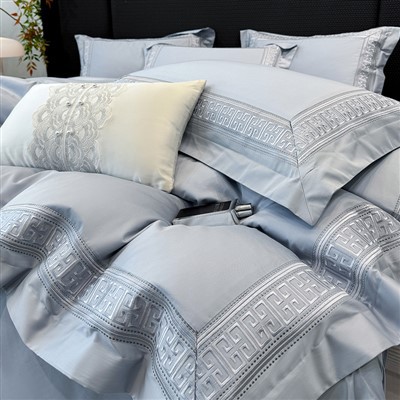
First, let’s start with the basics: absorbency, in textile terms, is the ability of a fabric to take in and hold liquid, right? But for bedding, it’s not just about how much water a piece can soak up—it’s about how quickly it wicks away moisture from your skin, how long it stays absorbent after multiple washes, and how it feels against you when you wake up in the middle of the night damp. A lot of people think cotton is inherently more absorbent than synthetic fabrics like polyester, and that’s true, but not all cotton is created equal. I’ve seen sets that claim to be cotton but barely feel damp after a test spill, and others that soak it up in seconds—so let’s get into what causes that gap.
Let’s talk about cotton structure first. Cotton is a natural cellulosic fiber, which means it’s made of long chains of glucose molecules. Each individual cotton fiber has a hollow core (called a lumen) and small twists along its length, plus tiny gaps (microcavities) between the fiber’s surface and its inner layers. These features are why cotton is absorbent in the first place: water gets trapped in the microcavities and the hollow lumen, rather than just sitting on top like it does on polyester, which has a smooth, non-porous surface. But here’s the catch—those hollow cores can be flattened or blocked during processing, especially if the cotton is low-quality. The cheap cotton we source from mass markets often has fibers that are shorter, more brittle, and have been chemically treated to make them look brighter or softer at first, but those treatments can seal the microcavities, reducing absorbency over time.
When it comes to multi-piece bedding sets—think the flat sheet, fitted sheet, pillowcases, and duvet cover, which is what most people buy—absorbency isn’t uniform across all pieces, either. The sheet you lay directly on top of your mattress is going to be more in contact with your skin, so it needs to be more absorbent than the duvet cover, which is usually a thicker outer layer. But many brands cut corners on all pieces, even the ones that need it most. For example, a set with a 200-thread-count cotton sheet (which is often made with low-quality, short-staple cotton) is going to be far less absorbent than a set with a 400-thread-count sheet made from long-staple cotton, like Egyptian or Pima cotton. Wait, hold on—thread count is a common buzzword, but it’s not the only factor, especially for absorbency. I always tell customers not to fixate solely on thread count, because a high thread count with low-quality fibers is still going to be less absorbent than a medium thread count with high-quality long-staple cotton.
Another big factor is the weave of the fabric. Multi-piece bedding sets come in different weaves: percale, sateen, jersey, flannel. Each weave affects absorbency differently. Let’s break that down. Percale is a plain, over-under weave that’s breathable, with a matte finish. Because the weave is tight but not dense, it leaves small gaps between the threads, which allows air and moisture to pass through quickly—percale is one of the most absorbent weaves for sheets, which is why we use it as a base for many of our best-selling cotton multi-piece sets. Sateen, on the other hand, is a weave that uses more weft threads (the threads that go left to right) than warp threads, which creates a smooth, silky finish. Sateen can be slightly less absorbent than percale because the extra threads cover more of the fiber’s surface, reducing the amount of microcavities exposed. That doesn’t mean sateen is bad—its softness is great for people who prefer a smoother feel—but if absorbency is your top priority, percale or jersey is a better bet. Flannel, of course, is brushed cotton, which has tiny extra fibers on the surface that trap moisture, making it very absorbent for cold nights when you might sweat under layers.
Then there’s processing and finishing. This is where we as suppliers can really make a difference, and where a lot of budget brands skimp. When we make our cotton multi-piece bedding sets, we avoid harsh chemical finishes that are designed to make fabric feel “soft” immediately but seal the fiber’s pores. Instead, we use a pre-washing process that softens the cotton naturally by relaxing the fibers before we cut and sew the set. We also use organic cotton for most of our lines, because organic cotton isn’t treated with the synthetic pesticides or bleaches that conventional cotton uses—those chemicals can damage the fiber’s hollow lumen over time, reducing absorbency. I remember a customer who bought a cheap cotton set a few years ago and returned it after two washes because it felt “sticky” when she sweated—turns out, the brand had used a permanent press finish to prevent wrinkles, which coated the fibers and made it so moisture couldn’t escape. That’s the kind of issue we work hard to avoid.
Now, how do we actually measure the absorbency of a cotton multi-piece bedding set? As someone who’s tested these sets hundreds of times, I can tell you there are two main methods that are accurate for bedding. The first is the water drop test, which is a quick at-home way to check. You take a small drop of water and place it on the surface of the sheet or pillowcase. If it spreads out and is absorbed within 10 seconds, that’s good absorbency; if it beads up and sits there for 30 seconds or more, the fabric has low absorbency, probably due to chemical finishes or low-quality fibers. But the more scientific test we use in our quality control lab is the wicking height test. We cut a 20cm x 2cm strip of fabric, submerge the bottom 1cm in water for 30 minutes, then measure how high the water has climbed up the strip. For high-quality cotton multi-piece bedding, the wicking height should be at least 5cm in 30 minutes—this means moisture is moving away from the surface, not sitting on top, which is exactly what you want for sleep.
What about durability of absorbency? That’s a huge point I don’t see many brands talk about. A set might be super absorbent when you first buy it, but after 10 or 20 washes, it might lose that ability. Why? Detergent residue, fabric softeners, and harsh washing cycles can build up on the cotton fibers, blocking their microcavities. We recommend using a mild, fragrance-free detergent and skipping fabric softeners for cotton bedding, because softeners coat the fibers with a waxy layer that reduces absorbency. In our testing, sets made with long-staple organic cotton that we pre-wash properly retain 90% of their absorbency after 50 washes, while low-quality conventional cotton sets often lose 40% of their absorbency after just 10 washes. That’s a big difference for people who wash their bedding weekly.
Now, let’s tie this all together to why absorbency matters for your sleep. I’ve had customers tell me they wake up in the middle of the night feeling clammy, even when the temperature is set right. That’s often because their bedding isn’t absorbing and wicking away their sweat fast enough, so it sits between their skin and the fabric, making them feel uncomfortable and disrupting deep sleep. For people who tend to run hot at night, or who experience night sweats during menopause or pregnancy, a highly absorbent cotton multi-piece set can make a huge difference. Even for people who sleep cool, absorbent bedding helps keep you dry if you accidentally spill water or tea on the set, or if you have pets that jump on the bed.
I want to be clear, though—absorbency isn’t the only thing that matters in a bedding set. You also want softness, durability, breathability, and fit. But when you’re choosing between cotton multi-piece sets, don’t just look for “100% cotton” on the tag. Ask about the cotton type (long-staple vs. short-staple), the weave, the processing, and how absorbency has been tested. As a supplier, I’m always happy to walk customers through this—we don’t hide details about our cotton’s origins or our quality control processes, because we know that a bedding set should last for years, and being comfortable every night is non-negotiable.
A common question I get is: is there a downside to highly absorbent cotton bedding? The only one I can think of is that, if you live in a very humid climate, a super absorbent set might take a little longer to dry than a synthetic one, but that’s a minor trade-off for most people, especially since cotton is more breathable overall. And if you air dry your bedding (which we recommend over machine drying, as heat can damage fibers), it dries just as quickly as any other cotton set anyway.
So, to wrap up what we’ve covered today: the absorbency of a cotton multi-piece bedding set depends on the type of cotton (long-staple = better), the weave (percale and jersey are more absorbent than sateen), the processing (no harsh chemicals, pre-washing to open fiber cavities), and how well the set is cared for (mild detergent, no fabric softeners). It’s not just a marketing buzzword—it’s a feature that directly impacts how comfortable you sleep every night.

If you’re in the market for a cotton multi-piece bedding set that prioritizes real, long-lasting absorbency, I encourage you to reach out to our team to discuss your needs. We can share details about our cotton sourcing, our quality testing processes, and help you find the right set for your climate, sleep preferences, and budget. Whether you’re looking for a set for a hot summer night, a cozy flannel set for winter, or a mid-weight percale set for year-round use, we have options that are designed to keep you dry and comfortable for years to come. Don’t settle for a cotton set that only feels good on the shelf—choose one that works for your nights.
100% Cotton 4-piece Sheet Set References
ASTM International. (2020). Standard Test Method for Water Absorbency of Textile Fabrics. ASTM D4772-20.
Cotton Council International. (2022). Cotton Fiber Properties and Their Impact on Bedding Performance. CottonWorks Research Report.
Textile Institute. (2019). The Influence of Weave Structure on Moisture Wicking and Absorbency of Cellulosic Fabrics. Journal of Textile Science and Fashion Technology, 3(2), 1-8.
Jiangsu Weisha New Energy Technology Co., Ltd.
As one of the most professional cotton multi-piece bedding set manufacturers in China, we’re featured by quality products and low price. Please rest assured to buy discount cotton multi-piece bedding set made in China here and get quotation from our factory. We also accept customized orders.
Address: Buildings 13-14, Standard Factory Building, Sanhe Kou Village, Chuanjiang Town, Tongzhou District, Nantong City, Jiangsu Province
E-mail: 348030855@qq.com
WebSite: https://www.weishatex.com/
