As a baby diaper machine supplier who’s worked with over 120 factories across North America and Southeast Asia over the last 8 years, I’ve seen firsthand how a single overlooked safety regulation can halt production, injure workers, or even sink a small manufacturing operation. Last year, a client in Mexico lost 3 weeks of output when an unguarded cutting blade on their used diaper machine caught a new operator’s hood, resulting in a $45,000 downtime fine and a 3-month OSHA audit. That incident wasn’t from a faulty machine—it was from a missing safety guard that the factory’s maintenance team had removed to speed up a production run and never reattached. BABY DIAPER MACHINE
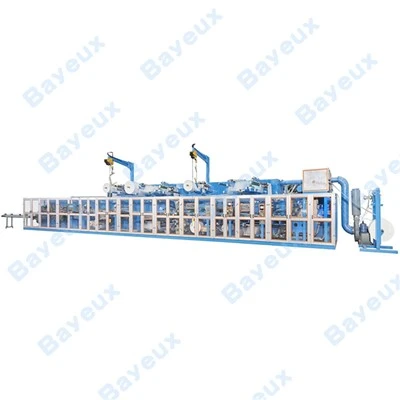
If you’re a factory owner or operations manager looking to set up or upgrade a diaper production line, understanding the specific safety regulations for baby diaper machines isn’t just a compliance box to tick—it’s the difference between a profitable, low-risk line and one that’s a constant source of headaches. Below, I’ll break down the non-negotiable safety standards we build into every machine we ship, plus the additional factory-level regulations that our partners must follow to keep their teams safe.
First, let’s start with machine-specific safety regulations that apply directly to the diaper production equipment itself. These are not arbitrary rules; they’re derived from ISO 13849, the international standard for machine safety, as well as OSHA’s General Industry Standards for powered machinery and the EU’s Machinery Directive for factories operating in the EEA. Every baby diaper machine has a few high-risk areas that require hard, non-bypassable safeguards.
The first is the forming and cutting station. This is where raw fluff pulp, superabsorbent polymer (SAP), and nonwoven fabric are shaped into the classic diaper pad form, and excess material is cut away. Most factories cut corners here: some use plastic safety guards that operators can easily push aside to clear jammed material, which is a violation of nearly every national safety regulation. The machines we design use steel interlocking guards that cannot be removed without a dedicated tool, and they’re wired to the machine’s emergency stop (E-stop) system. If the guard is opened mid-run, the entire line shuts down automatically—no exceptions. OSHA’s 29 CFR 1910.217 specifies that all point-of-operation machinery guards must be “intrinsically safe” to remove, meaning they require a tool that only maintenance or trained safety staff possess. We also build our cutting blades with a shear design, not a guillotine design, which reduces the cutting force by 60% compared to older machine models. That’s a small detail that cuts down on severe lacerations, one of the most common injuries in diaper manufacturing.
Next, the SAP dispensing system is often a hidden hazard. Superabsorbent polymer is a fine, dust-like material that, when airborne, can cause respiratory irritation, block factory ventilation systems, and even create a dust explosion risk if concentrations hit 30 g/m³ (the lower explosive limit for cellulose-based dust, which SAP is derived from). OSHA’s 29 CFR 1910.1000 sets a permissible exposure limit (PEL) for respirable dust at 15 mg/m³ over an 8-hour shift, and ISO 14644 requires closed dispensing systems with integrated dust extraction that runs at all times during production. We don’t sell any machine that relies on manual SAP loading, because that’s a guaranteed way to overexpose workers. Our machines have fully automated, sealed SAP hoppers that only open for refill when the line is shut down, and the extraction system is linked to the hopper’s door: if the extractor fails for any reason, the hopper can’t be opened, and the line pauses. We also include real-time dust concentration monitors that send alerts to both the machine operator and the factory’s safety manager if levels exceed OSHA’s PEL. Last year, a partner in Ohio installed our monitors and found that their old machine’s extractor was failing by 20%—they fixed it immediately, avoiding a potential OSHA fine of $13,000 for unaddressed dust hazards.
Then there’s the material handling and web path system. Diaper production lines use continuous webs of nonwoven fabric, elastic, and tape that run at speeds up to 600 meters per minute—fast enough that a loose sleeve or long hair can get caught in the web rollers, leading to amputations. The Federal Food, Drug, and Cosmetic Act (FDCA), which also governs manufacturing equipment for consumer products, requires that all web handling components have nip points (areas where two rollers meet, which can pinch skin) guarded with either fixed barriers or presence-sensing safety mats. Our machines use presence-sensing light curtains along the entire web path, not just the high-risk sections. If an operator reaches into the web path to clear a jam, the light curtains trigger an E-stop within 0.12 seconds—faster than a human can pull their hand back. We also design our web rollers with rounded edges to reduce the severity of any pinch, but the light curtains are the non-negotiable safeguard here. A common mistake I see new factory owners make is turning down light curtain sensitivity to reduce false stops, which creates a major safety gap. We train all our clients to never disable these systems, and we include remote access tools to audit light curtain performance during routine maintenance checks.
Now, beyond machine-specific regulations, there are factory-level safety rules that apply to the entire production area, which our partners must adhere to. These are often just as critical as the machine’s built-in safeguards, because even the safest machine won’t prevent an injury if the factory has poor layout or training protocols.
First, machine guarding zones. OSHA requires that all diaper production lines have a 3-foot clear zone around every side of the machine, so operators don’t crowd high-risk areas. We work closely with factories to layout lines so the loading, maintenance, and E-stop access points are all on the same side, reducing the chance of workers walking into unguarded nip points. I once visited a factory in Brazil that had their diaper line tucked into a 2-foot wide corner, with no clear access for maintenance. When the line jammed, a maintenance worker had to reach over a roller to clear it, and they lost a finger to the blade—all because the factory skipped the clear zone to save floor space. That’s not a machine problem; it’s a factory layout problem that’s entirely avoidable.
Second, lockout/tagout (LOTO) procedures. This is one of the most frequently violated safety standards in manufacturing, and diaper lines are no exception. LOTO requires that any machine being serviced has its power source locked and tagged by the worker performing the service, so no one can turn it on unexpectedly. For diaper machines, which have multiple power sources (main line, SAP dispenser, web unwind), we provide color-coded LOTO locks that are specific to each machine’s components. OSHA’s 29 CFR 1910.147 mandates that all factory workers who service powered machinery be trained in LOTO annually, and our team conducts free LOTO training for every new client within their first 3 months of using our machines. We also build LOTO compliance prompts into the machine’s control panel: if a maintenance worker tries to access the cutting station without engaging LOTO, the panel displays a large, flashing “LOCKOUT REQUIRED” message and won’t allow access to the station’s controls.
Third, emergency preparedness. Diaper factories have unique emergency risks: dust explosions from SAP, chemical exposure from adhesive used in diaper tabs, and even fire from the plastic components in diapers. NFPA 68, the standard for deflagration explosions prevention, requires that factories with dust-generating equipment (like diaper machines) have explosion vents on their production areas, and that all workers are trained on dust explosion response. We work with our clients to review their emergency plans, and we include fire suppression systems specifically rated for dust fires in every machine we ship. Last year, a partner in Thailand had a small dust explosion in their SAP hopper—our machine’s built-in explosion vent activated, and the suppression system put it out before it could spread to the entire line. They avoided a catastrophic loss that would have shut down the factory for months.
Training is another non-negotiable part of safety regulation, and it’s an area where many cutting corners lead to injuries. OSHA requires that all new operators of diaper machines complete 40 hours of hands-on training and 8 hours of safety-specific training before working independently. The training can’t just be about how to run the machine—it has to cover recognizing hazards, responding to E-stops, LOTO procedures, and dust exposure. We offer two types of training: on-site training at our facilities in the U.S. and Germany, and virtual training for factories that can’t travel. We also provide digital training modules that operators must complete before they’re allowed to access the machine’s control panel. A common complaint we hear from small factories is that training takes time away from production, but the alternative is far more costly: a single injury can cost $100,000 or more in workers’ comp, downtime, and fines.
I’ll be the first to admit that safety regulations for baby diaper machines can feel overwhelming, especially if you’re setting up a line for the first time. That’s why we don’t just sell machines—we partner with our clients to make sure they understand and comply with every regulation, from machine-specific guards to factory-wide LOTO plans. Over the years, we’ve learned that the best safety programs aren’t just about following rules; they’re about building systems that make safety easy, not a hassle. Our machines have redundant safeguards, real-time monitoring, and compliance prompts built in so that workers don’t have to choose between safety and speed.
If you’re looking to upgrade your diaper production line, or if you have questions about adapting your existing line to meet current safety regulations, our team is here to help. We work with factories of all sizes, from small start-ups to large multinational consumer goods brands, and we can provide customized solutions that fit your budget and compliance needs. There’s no one-size-fits-all when it comes to safety, but we’ve seen what works, and we’re ready to share that expertise with you.
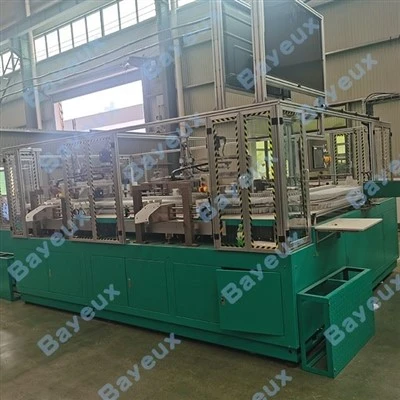
Don’t wait for an audit or an injury to address your machine’s safety. Reach out to our team today to schedule a consultation, and let’s make your production line as safe as it is profitable.
EVA Raw Material References
OSHA General Industry Standards 29 CFR Part 1910
ISO 13849-1:2020, Safety of machinery – Safety-related parts of control systems
NFPA 68: Standard on Explosion Protection by Deflagration Venting
U.S. Food and Drug Administration, 21 CFR Part 110, Current Good Manufacturing Practice in Manufacturing, Processing, Packing, or Holding Operations for Human Food
Quanzhou Bayeux Industrial Co., Ltd.
Address: ROOM 805,BUILDING 3,NO,8 XIANGSHAN ROAD, XIANGSHAN COMMUNITY, QINGYANG STREET, JINJIANG QUANZHOU FUJIAN.
E-mail: yeliqun_520@163.com
WebSite: https://www.qzbayeux.com/
